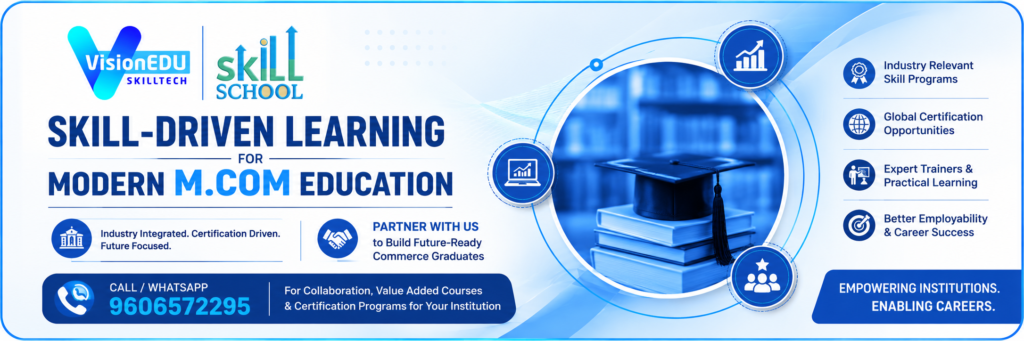
Skill-Driven Learning for Modern M.Com Education
Building Industry-Ready M.Com Graduates Through Value Added Courses
In today’s rapidly evolving business environment, traditional classroom education alone is no longer sufficient to prepare students for the demands of the corporate world. Employers are increasingly seeking commerce graduates who possess not only academic knowledge but also practical industry-oriented skills that can be applied immediately in professional environments.
For M.Com programs, this shift is especially significant. Postgraduate commerce students are expected to demonstrate advanced competencies in finance, taxation, analytics, technology, communication, and business decision-making. As industries continue to embrace digital transformation, automation, and AI-driven operations, higher education institutions must align their academic delivery with current industry expectations.
This is where value added courses play a transformative role.
The Growing Need for Industry-Oriented Learning
Across India, universities and accreditation bodies are encouraging institutions to focus on employability, skill enhancement, and experiential learning. While M.Com curricula provide strong theoretical foundations, there is often a noticeable gap between academic learning and practical corporate requirements.
Many students complete postgraduate programs without exposure to:
- Advanced business tools
- ERP systems
- Financial analytics
- AI-enabled workflows
- Practical taxation processes
- Corporate reporting practices
As a result, institutions are now increasingly integrating value added courses into their M.Com programs to enhance employability and industry readiness.
These programs help students:
- Gain practical exposure
- Build confidence
- Improve placement opportunities
- Understand real-world business environments
- Develop technology-driven competencies
For colleges, such initiatives also contribute positively toward:
- NAAC quality parameters
- Skill enhancement initiatives
- Industry collaborations
- Placement performance
- Student progression outcomes
Why Value Added Courses Matter for M.Com Students
The commerce and finance sector has undergone major transformation in recent years. Traditional accounting roles are evolving into analytical and technology-driven functions. Employers now expect graduates to be proficient in digital tools, data interpretation, and business automation.
Value added courses bridge this gap by providing hands-on training in areas that are highly relevant to modern industry requirements.
Some of the most impactful domains for M.Com students include:
Advanced Excel and Business Analytics
Data-driven decision-making is now central to business operations. Practical training in Advanced Excel, dashboards, MIS reporting, and analytics helps students become workplace-ready.
GST and Practical Taxation
Industry-oriented taxation training equips students with practical exposure to GST filing, income tax procedures, TDS calculations, and compliance management.
AI Tools for Commerce Professionals
AI is rapidly changing finance and accounting operations. Training students in AI-enabled reporting, automation tools, and productivity applications provides a strong competitive advantage.
SAP FICO and ERP Exposure
ERP systems are widely used across industries. Exposure to SAP fundamentals helps students understand real-time business and finance processes.
Financial Modelling and Investment Analysis
For finance-oriented careers, practical training in financial statement analysis, budgeting, valuation, and forecasting significantly enhances employability.
Building Employability Beyond the Classroom
Today’s employers value practical skills, adaptability, communication, and technological awareness alongside academic performance.
An industry-ready M.Com graduate should ideally possess:
- Analytical thinking abilities
- Digital proficiency
- Practical finance exposure
- Professional communication skills
- Business presentation capabilities
- Problem-solving orientation
Value added certification programs help students develop these competencies through:
- Practical sessions
- Case studies
- Simulations
- Industry projects
- Interactive workshops
- Certification assessments
This approach enables students to transition more confidently from academics into professional careers.
The Institutional Advantage
For higher education institutions, integrating value added programs into M.Com departments creates multiple long-term advantages.
Enhanced Student Employability
Placement-oriented certifications improve student confidence and career readiness.
Stronger Industry Collaboration
Industry-integrated learning strengthens institutional relationships with corporate partners and training organizations.
Improved Admissions Appeal
Students and parents increasingly prefer institutions that offer practical skill development alongside academics.
Better Accreditation Support
Skill enhancement initiatives contribute positively toward institutional quality frameworks and documentation processes.
Differentiation in a Competitive Market
Institutions that focus on employability-driven education stand out in an increasingly competitive higher education landscape.
The VisionEDU SkillTech Approach
VisionEDU SkillTech works closely with higher education institutions to design and deliver industry-oriented value added programs tailored for commerce, management, and professional studies students.
The focus is on creating practical, technology-enabled, and employability-driven learning experiences that align with current industry expectations.
Key features of the programs include:
- Industry-relevant curriculum
- Experienced corporate trainers
- Practical learning methodology
- Certification-based structure
- AI-enabled learning integration
- Placement-oriented approach
- Customization for institutional requirements
For M.Com students, VisionEDU SkillTech offers programs in:
- Business Analytics
- Advanced Excel
- GST & Taxation
- SAP FICO
- Financial Modelling
- AI for Commerce Professionals
- Banking & Finance
- Research & Data Analytics
Programs can be structured as:
- 30-hour value added courses
- Semester-integrated modules
- Certification workshops
- Skill enhancement programs
- Faculty development initiatives
Preparing Students for the Future
The future of commerce education lies in combining academic excellence with practical industry readiness. Institutions that proactively integrate employability-focused learning into postgraduate commerce education will be better positioned to support student success in the years ahead.
As business environments continue to evolve through AI, analytics, automation, and digital transformation, M.Com graduates must be equipped with skills that go beyond traditional classroom learning.
Value added courses are no longer optional enhancements—they are becoming essential components of modern higher education.
Conclusion
Building industry-ready M.Com graduates requires a strategic blend of academic foundations, practical exposure, digital competencies, and industry engagement. Institutions that invest in skill enhancement and certification-oriented learning create stronger outcomes for students, employers, and the institution itself.
By collaborating with organizations like VisionEDU SkillTech, colleges can introduce impactful, future-ready learning solutions that empower commerce students with the skills needed to succeed in the evolving corporate world.
For institutions seeking to strengthen employability initiatives, industry integration, and value added learning frameworks for M.Com students, VisionEDU SkillTech provides scalable and institution-focused academic collaboration models tailored for higher education.
For institutional collaborations, value added courses, certification programs, and industry-integrated training initiatives for commerce and management students, contact VisionEDU SkillTech.
Call / WhatsApp: 9606572295
VisionEDU SkillTech