
Artificial Intelligence (AI) is rapidly transforming the way we work, learn, and create. From writing emails and generating images to coding applications and analyzing data, AI tools like OpenAI ChatGPT, Google Gemini, and Microsoft Copilot are becoming part of everyday life.
But have you ever noticed that sometimes AI gives brilliant answers, while other times the response feels incomplete or confusing? The secret often lies in Prompt Engineering.Edit or delete it, then start writing!
What is Prompt Engineering?
Prompt Engineering is the process of designing clear and effective instructions (called prompts) to get the best possible output from an AI system.
Simply put:
Better prompts = Better AI responses
A prompt can be:
- A question
- A command
- A scenario
- A detailed instruction
- Or even a conversation
For example:
Basic Prompt:
“Write about marketing.”
Better Prompt:
“Write a 300-word blog explaining digital marketing trends for MBA students in simple language with examples.”
The second prompt gives the AI more clarity, resulting in a more focused and useful response.
Why is Prompt Engineering Important?
Prompt Engineering helps users:
- Get accurate answers
- Save time
- Improve productivity
- Generate creative content
- Automate repetitive tasks
- Improve learning and research
Today, professionals in:
- Education
- Marketing
- Software Development
- Finance
- HR
- Law
- Healthcare
- Design
are using prompt engineering skills to work smarter with AI tools.
How AI Understands Prompts
AI models work by predicting patterns based on the instructions given by users. They do not “think” like humans but respond based on:
- Context
- Keywords
- Intent
- Structure of the prompt
That is why prompt quality matters.
A vague prompt creates vague results.
A clear and structured prompt creates high-quality responses.
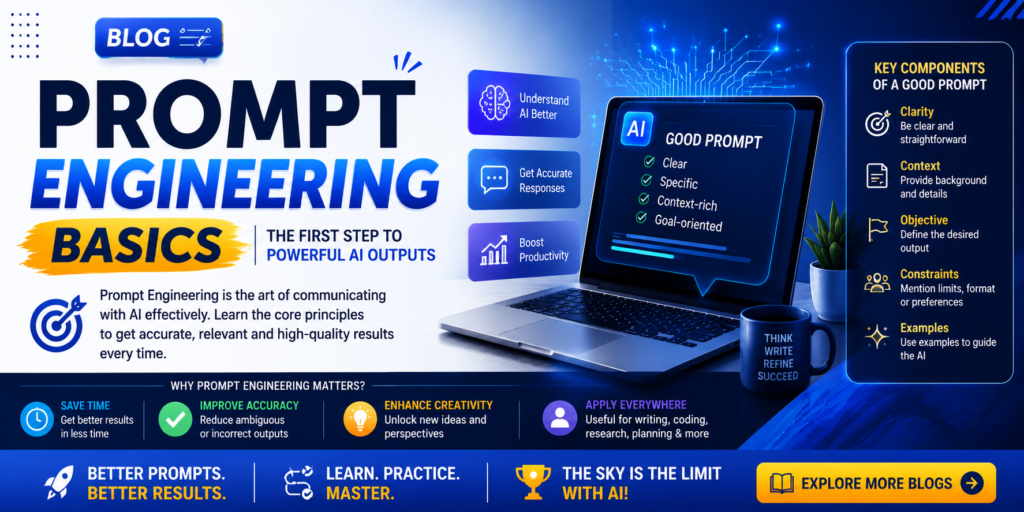
Components of a Good Prompt
A powerful prompt usually contains the following elements:
1. Clear Objective
Tell the AI exactly what you want.
Example:
- “Explain blockchain technology.”
2. Context
Provide background information.
Example:
- “Explain blockchain technology for B.Com students.”
3. Format
Specify how you want the response.
Example:
- “Explain blockchain technology in bullet points.”
4. Tone or Style
Mention the writing style.
Example:
- “Use simple and beginner-friendly language.”
5. Length or Depth
Define response size.
Example:
- “Write in 500 words.”
Types of Prompt Engineering
1. Zero-Shot Prompting
The AI is asked directly without examples.
Example:
“Write a resume summary for an MBA student.”
2. One-Shot Prompting
One example is provided.
Example:
“Example: Customer service email reply…
Now write a similar response for a delayed delivery complaint.”
3. Few-Shot Prompting
Multiple examples are provided to guide AI behavior.
This method improves consistency and accuracy.
4. Chain-of-Thought Prompting
The AI is instructed to think step-by-step.
Example:
“Explain step-by-step how to calculate profit percentage.”
This technique is especially useful in:
- Mathematics
- Coding
- Logical reasoning
- Problem-solving
Real-Life Examples of Prompt Engineering
Example 1: Content Writing
Weak Prompt:
“Write a social media post.”
Strong Prompt:
“Write a professional LinkedIn post about AI in education for college principals in India.”
Example 2: Resume Building
Weak Prompt:
“Make my resume better.”
Strong Prompt:
“Rewrite my resume for an HR Manager role with strong action verbs and ATS-friendly formatting.”
Example 3: Learning Support
Weak Prompt:
“Teach me Excel.”
Strong Prompt:
“Teach me Advanced Excel formulas for finance students with practical examples.”
Best Practices for Beginners
Be Specific
Avoid vague instructions.
Instead of:
- “Tell me about AI”
Use:
- “Explain AI applications in banking for MBA students.”
Use Step-by-Step Instructions
Break complex tasks into parts.
Example:
- Explain the concept
- Give examples
- Share practical applications
Experiment and Refine
Prompt engineering is an iterative process.
If the output is not satisfactory:
- Rephrase the prompt
- Add more details
- Change tone or format
Define Audience
Mention who the content is for.
Examples:
- Beginners
- Students
- CEOs
- Developers
- Customers
Ask AI to Act as a Role
Example:
“Act as a career counselor and guide a BBA student.”
This improves contextual responses.
Common Mistakes Beginners Make
1. Using Very Short Prompts
Short prompts often lack clarity.
2. Giving Multiple Unclear Instructions
Avoid confusing the AI.
3. Not Mentioning the Target Audience
Audience clarity improves output quality.
4. Ignoring Output Format
Always specify whether you need:
- Table
- Bullet points
- Blog
- Presentation
- Summary
Future of Prompt Engineering
Prompt Engineering is becoming one of the most valuable digital skills in the AI era.
As AI adoption grows, professionals who know how to communicate effectively with AI tools will have a major advantage in:
- Career growth
- Productivity
- Innovation
- Automation
Many companies are already hiring professionals with AI and prompt engineering skills.
Final Thoughts
Prompt Engineering is not just a technical skill — it is the art of communicating effectively with AI.
You do not need to be a programmer to learn it. Anyone can master prompt engineering with practice, creativity, and curiosity.
Whether you are:
- A student
- Teacher
- Entrepreneur
- Corporate professional
- Content creator
- Developer
learning prompt engineering can help you unlock the true power of AI.
The future belongs to people who can work intelligently with AI – and prompt engineering is the first step in that journey.