AI in Higher Education: Transforming Universities, Teaching, and Student Success
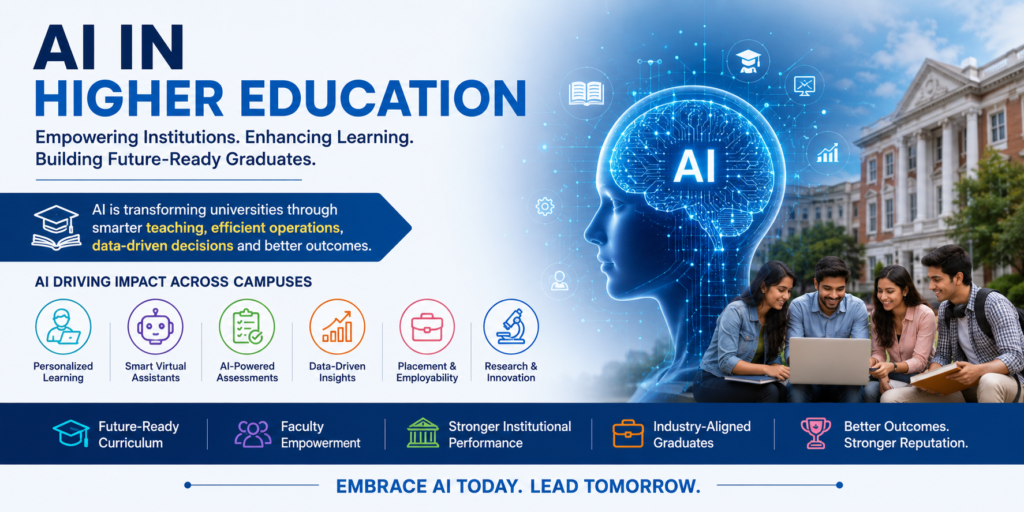
The integration of Artificial Intelligence (AI) in higher education is no longer a futuristic concept – it is rapidly becoming a strategic necessity for universities and colleges across India and the world. From personalized learning experiences to automated administrative processes, AI is reshaping how institutions teach, manage operations, engage students, and prepare graduates for the future workforce.
For Principals, Directors, Deans, and Heads of Departments (HODs), adopting AI-driven education strategies is now essential to improve institutional outcomes, enhance employability, attract quality admissions, and strengthen academic excellence.
In this article, we explore how AI in higher education is revolutionizing teaching, learning, administration, and industry readiness.
What is AI in Higher Education?
Artificial Intelligence in higher education refers to the use of intelligent technologies such as machine learning, generative AI, predictive analytics, natural language processing, and automation tools to improve academic delivery, institutional management, and student engagement.
AI-powered systems can analyze data, automate repetitive tasks, personalize education, and provide insights that help institutions make better decisions.
Today, universities are using AI for:
- Smart learning management systems
- AI-powered assessments
- Student performance analytics
- Virtual teaching assistants
- Automated admissions and support
- Research enhancement
- Industry-focused skill development
- Career guidance and placement support
The institutions that embrace AI today are positioning themselves as future-ready campuses.
Why AI Matters for Higher Education Institutions
The education landscape is evolving rapidly. Students expect technology-enabled learning experiences that are practical, flexible, and industry-oriented. Employers are seeking graduates who understand AI tools, digital workflows, automation, and data-driven decision-making.
Higher education institutions that integrate AI effectively can achieve several strategic advantages:
1. Improved Student Learning Outcomes
AI helps create personalized learning experiences based on individual student performance, learning pace, and engagement levels. Adaptive learning platforms can identify weak areas and recommend customized learning resources.
This improves:
- Academic performance
- Student retention
- Concept clarity
- Learning engagement
Students receive support tailored to their learning style rather than a one-size-fits-all approach.
2. Enhanced Faculty Productivity
Faculty members spend significant time on repetitive academic and administrative tasks such as attendance tracking, grading, report preparation, and content management.
AI tools can automate many of these processes, allowing faculty to focus more on:
- Teaching quality
- Research activities
- Mentorship
- Curriculum innovation
- Student interaction
AI also assists educators in creating lesson plans, question banks, presentations, case studies, and assessment rubrics more efficiently.
3. Data-Driven Decision Making
Modern institutions generate enormous amounts of data related to admissions, attendance, academic performance, placements, and student engagement.
AI analytics platforms help institutional leaders:
- Identify at-risk students
- Improve academic planning
- Forecast admissions trends
- Optimize resource allocation
- Enhance placement readiness
This enables Principals and HODs to make informed strategic decisions backed by real-time insights.
Applications of AI in Higher Education
AI-Powered Personalized Learning
Traditional classroom teaching often struggles to address varying student learning abilities. AI-based learning systems adapt content according to student performance and engagement.
For example:
- Advanced learners receive higher-level challenges
- Slow learners receive additional support and simplified explanations
- Students receive instant feedback and recommendations
This creates a more inclusive and effective learning environment.
Smart Virtual Assistants and Chatbots
AI chatbots are increasingly being used in universities for:
- Admission queries
- Student support
- Timetable assistance
- Fee information
- Examination updates
- Course guidance
These virtual assistants provide 24/7 support, improving communication efficiency and student satisfaction.
AI in Assessments and Evaluation
AI can automate evaluation processes for objective assessments and assist in analyzing descriptive answers using intelligent grading systems.
Benefits include:
- Faster result processing
- Reduced faculty workload
- Consistent evaluation standards
- Detailed performance analytics
AI-based proctoring systems are also helping institutions conduct secure online examinations.
AI for Placement and Employability
One of the biggest priorities for educational institutions today is improving placements and employability outcomes.
AI-driven career platforms can:
- Analyze student skill gaps
- Recommend certification programs
- Suggest career pathways
- Conduct mock interviews
- Evaluate resumes
- Match students with industry opportunities
Institutions that integrate AI-focused skill training significantly improve their placement competitiveness.
AI in Research and Innovation
Research scholars and faculty members are increasingly using AI tools for:
- Literature reviews
- Data analysis
- Research modeling
- Academic writing support
- Statistical interpretation
AI accelerates research productivity while enabling interdisciplinary innovation.
This is especially relevant for engineering, management, commerce, computer applications, law, and healthcare programs.
Benefits of AI Adoption for Colleges and Universities
Better Institutional Branding
Institutions offering AI-integrated programs attract more attention from students, parents, recruiters, and accreditation bodies.
AI-enabled campuses are perceived as:
- Innovative
- Industry-oriented
- Future-ready
- Technology-driven
This enhances institutional reputation and market positioning.
Improved Admissions Potential
Students today actively seek colleges that offer:
- AI certifications
- Industry-integrated learning
- Practical training
- Technology-enabled classrooms
- Employability-focused programs
Introducing AI initiatives helps institutions attract quality students and strengthen admissions performance.
Industry Alignment
Companies across sectors are adopting AI technologies. Institutions that incorporate AI learning into academic delivery produce graduates who are better prepared for modern workplace requirements.
This strengthens:
- Placement opportunities
- Corporate collaborations
- Internship partnerships
- Industry engagement
Challenges in Implementing AI in Higher Education
While AI offers tremendous opportunities, institutions must also address implementation challenges.
Faculty Training and Readiness
Faculty development is critical for successful AI integration. Educators must be trained in:
- AI tools and applications
- Prompt engineering
- Digital pedagogy
- AI-assisted teaching methodologies
Continuous faculty upskilling is essential.
Infrastructure Requirements
Institutions require:
- Reliable internet connectivity
- Digital classrooms
- Learning management systems
- AI software tools
- Cloud-based platforms
Technology investment plays a major role in successful adoption.
Ethical and Data Privacy Concerns
Institutions must establish clear policies regarding:
- Student data protection
- AI-generated content usage
- Academic integrity
- Responsible AI practices
AI should enhance learning—not replace human mentorship and critical thinking.
The Future of AI in Higher Education
The future of higher education will be deeply connected with AI-driven learning ecosystems.
Emerging trends include:
- AI tutors for personalized mentoring
- Intelligent curriculum mapping
- Predictive student success models
- AI-generated simulations and labs
- Virtual and immersive classrooms
- AI-powered academic advising
Institutions that adapt early will gain a significant competitive advantage.
Strategic Recommendations for Principals and HODs
To successfully implement AI in higher education, institutional leaders should focus on:
1. Introduce AI Literacy Across Departments
AI should not be limited to computer science programs. Commerce, management, law, arts, and science students also need AI exposure.
2. Invest in Faculty Development
Conduct AI training workshops and certification programs for faculty members.
3. Collaborate with Industry Partners
Partner with training organizations and technology companies to deliver practical AI-based learning.
4. Launch Industry-Oriented Certification Programs
Short-term AI, Prompt Engineering, Business Analytics, Data Science, and Automation courses improve student employability.
5. Create an AI Innovation Ecosystem
Encourage hackathons, research projects, AI clubs, innovation labs, and interdisciplinary collaboration.
Conclusion
Artificial Intelligence is transforming higher education at every level—from classrooms and curriculum delivery to administration and employability. Institutions that strategically embrace AI will be better equipped to enhance academic quality, improve operational efficiency, attract students, and build stronger industry connections.
For Principals, Directors, and Heads of Departments, AI adoption is no longer optional. It is a strategic investment toward building future-ready institutions capable of meeting the evolving demands of students, employers, and the global education ecosystem.
Higher education institutions that act today will lead tomorrow’s academic and professional landscape.
Contact 9606572295 for booking a comprehensive session.