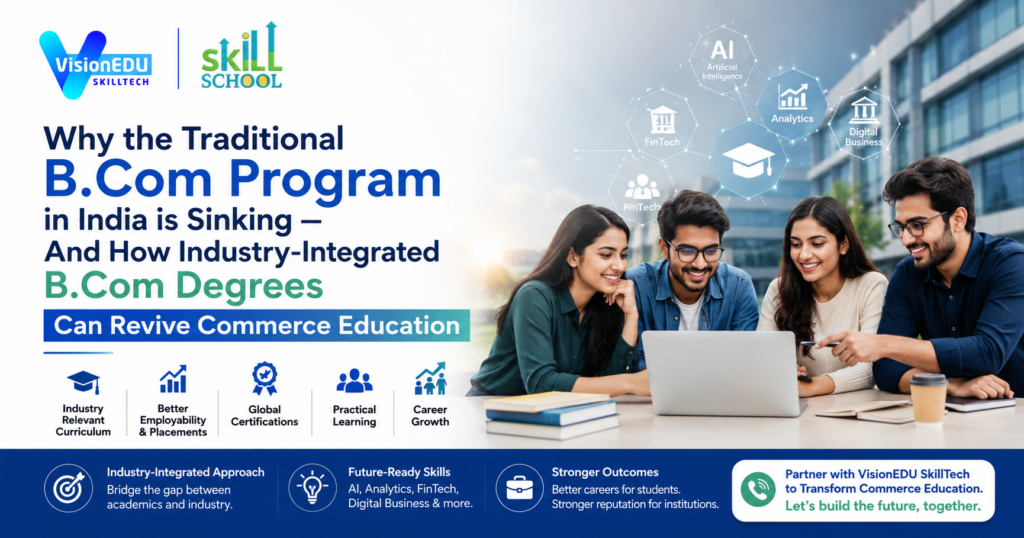
Why the Traditional B.Com Program in India is Sinking – And How Industry-Integrated B.Com Degrees Can Revive Commerce Education
For decades, the Bachelor of Commerce (B.Com) degree was considered one of the safest and most respected undergraduate programs in India. It was the preferred choice for students aspiring to build careers in accounting, banking, finance, taxation, insurance, and business management. Yet today, thousands of colleges across India are witnessing a worrying trend — declining admissions in traditional B.Com programs.
Many institutions are struggling to fill seats. Students are increasingly choosing professional certifications, technology-driven programs, or skill-based degrees over conventional commerce education. The question educational institutions must ask is no longer “Why are admissions falling?” but rather “How can B.Com be transformed to remain relevant in the modern economy?”
The answer lies in one critical shift:
B.Com Must Move from Theory-Based Learning to Industry-Integrated Career Education
India’s commerce ecosystem has changed dramatically in the last decade. Businesses are digitized. Finance is automated. Banking is technology-driven. Taxation is software-enabled. Analytics and AI are becoming part of every business decision.
However, many traditional B.Com programs are still teaching outdated syllabus structures with limited exposure to practical tools, industry projects, digital business models, or employability skills.
As a result:
- Students graduate with degrees but without job-ready skills.
- Employers struggle to find industry-trained commerce graduates.
- Institutions lose admissions due to lack of differentiation.
- Students prefer certifications and short-term career-oriented programs.
The reality is simple:
The future belongs to career-integrated B.Com programs, not conventional classroom-only commerce degrees.
The Real Reasons Why B.Com Admissions Are Falling in India
1. Lack of Industry Relevance
Most traditional B.Com programs focus heavily on textbook theory while industries demand practical skills.
Employers today expect graduates to know:
- Advanced Excel
- ERP tools
- SAP
- Tally
- GST filing
- Financial analytics
- Digital business processes
- AI tools
- Data interpretation
- Business communication
Unfortunately, many graduates complete B.Com without exposure to these tools.
2. Students Want Employability, Not Just Degrees
Today’s students and parents evaluate courses based on:
- Placement opportunities
- Salary potential
- Industry exposure
- Internship opportunities
- Certifications
- Future-ready skills
A generic B.Com degree no longer creates excitement among aspirants.
3. Commerce Careers Have Changed Dramatically
The commerce industry itself has evolved:
- Banking has become fintech-driven
- Accounting is cloud-based
- Taxation is software-enabled
- Marketing is digital
- Supply chains are analytics-driven
- Businesses depend on AI and automation
Traditional B.Com curriculum has not evolved at the same speed.
4. Competition from Specialized Programs
Students now prefer:
- BBA in Business Analytics
- FinTech programs
- Digital Marketing certifications
- Data Analytics programs
- AI-enabled business programs
This has made traditional B.Com appear outdated unless transformed properly.
The Future of Commerce Education: Industry-Integrated B.Com Programs
The future of commerce education is not about removing core commerce subjects. Instead, it is about integrating industry-oriented specializations and future-ready skills into the degree structure.
Institutions that survive and grow in the coming years will be those that redesign B.Com into a modern career ecosystem.
What Should the New-Age B.Com Program Include?
A future-ready B.Com degree should combine:
- Core commerce fundamentals
- Technology integration
- Industry certifications
- Employability skills
- Live projects
- Internship exposure
- Career pathways
Below are some of the most in-demand value-added programs that can dramatically increase the relevance of B.Com education.
1. Artificial Intelligence (AI) for Commerce Students
AI is no longer limited to engineering or IT sectors.
Commerce graduates are increasingly expected to understand:
- AI-driven business processes
- AI tools for productivity
- AI-based reporting
- AI-assisted accounting
- AI-powered customer analytics
- AI in finance and banking
Students trained in AI applications for commerce will have a major advantage in the future job market.
2. Prompt Engineering
Prompt Engineering is emerging as one of the most powerful workplace skills globally.
Commerce students can use prompt engineering for:
- Financial analysis
- Business report generation
- Content creation
- Market research
- Customer communication
- Data summarization
- Business planning
Institutions integrating Prompt Engineering into B.Com programs position themselves as future-ready campuses.
3. Business Analytics
Every business today depends on data-driven decisions.
Commerce students trained in:
- Advanced Excel
- Power BI
- Tableau
- Python basics
- Data visualization
- Predictive analytics
can access opportunities across:
- Banking
- Retail
- Insurance
- E-commerce
- Financial services
- Logistics
Business Analytics has become one of the strongest career pathways for commerce graduates.
4. Financial Modelling
Financial modelling skills are highly demanded in:
- Investment banking
- Equity research
- Corporate finance
- Startups
- Financial consulting
Students trained in:
- Ratio analysis
- Forecasting
- Valuation models
- Budgeting
- Financial projections
become far more employable than traditional graduates.
5. Accounts, Taxation & Finance
Accounting continues to remain the backbone of commerce careers. However, modern accounting education must include:
- GST compliance
- Income tax filing
- TDS
- Payroll processing
- ERP accounting
- Tally Prime
- SAP FICO
- Cloud accounting
Practical exposure creates immediate job readiness.
6. FinTech & Banking
India’s fintech ecosystem is among the fastest growing globally.
Digital banking, UPI, payment systems, neo banking, and financial technology startups are creating massive career opportunities.
A modern B.Com should include:
- Digital banking
- FinTech operations
- Financial technologies
- Investment products
- Wealth management
- Mutual funds
- Digital payments
- Banking compliance
7. Insurance & Risk Management
The insurance sector in India continues to expand rapidly due to:
- Financial awareness
- Corporate insurance
- Health insurance growth
- Regulatory expansion
Specialization in:
- Insurance operations
- Claims processing
- Underwriting
- Risk analysis
- Financial protection products
can create strong employability.
8. Logistics & Supply Chain Management
E-commerce growth has transformed logistics into a massive employment sector.
Commerce graduates trained in:
- Inventory management
- Procurement
- Supply chain analytics
- Warehouse operations
- Export-import documentation
- Logistics technology
can access opportunities in global supply chains.
9. Digital Marketing & E-Commerce
Modern businesses need commerce graduates who understand:
- SEO
- Social media marketing
- Performance marketing
- Content marketing
- E-commerce operations
- CRM tools
- Consumer analytics
Digital business skills significantly improve employability.
10. Entrepreneurship & Startup Management
India’s startup ecosystem is booming.
B.Com students should be trained in:
- Startup planning
- Business models
- Fundraising basics
- Business communication
- Financial planning
- Market validation
- AI-driven entrepreneurship
This creates job creators, not just job seekers.
Career Opportunities for Modern B.Com Graduates in India
India’s commerce and business ecosystem is generating enormous employment opportunities.
Some of the fastest-growing career roles include:
- Financial Analyst
- GST Executive
- Tax Consultant
- Business Analyst
- Banking Associate
- FinTech Operations Executive
- Digital Marketing Executive
- Payroll Specialist
- Investment Analyst
- Data Analyst
- Supply Chain Executive
- Insurance Advisor
- ERP Executive
- SAP Functional Consultant
- AI Business Process Associate
India currently witnesses lakhs of job openings annually across:
- Banking & Financial Services
- FinTech
- E-commerce
- Logistics
- Retail
- Consulting
- Insurance
- Startups
- Analytics
However, industries are increasingly hiring skill-ready graduates rather than degree-only candidates.
This is where institutions must rethink their B.Com model.
What Should Institutions Rename or Reposition Their B.Com Programs As?
Modern branding also matters.
Institutions may consider introducing innovative program structures such as:
- B.Com Industry Integrated
- B.Com Professional
- B.Com FutureReady
- B.Com with Business Analytics
- B.Com FinTech & AI
- B.Com Digital Business
- B.Com Employability Integrated
- B.Com Corporate Excellence
- B.Com Global Business
- B.Com with Financial Technologies
- B.Com Smart Commerce
- B.Com Industry 4.0
- B.Com Applied Commerce
- B.Com Tech-Integrated Commerce
These names immediately communicate relevance and differentiation.
Choosing the Right B.Com Program: What Students Must Look For
Students and parents must evaluate B.Com programs carefully before admission.
A good B.Com program should provide:
- Industry certifications
- Practical training
- Internship opportunities
- Placement support
- Technology integration
- AI exposure
- Analytics learning
- Corporate projects
- Industry mentors
- Career mapping
The future belongs to institutions that focus on career outcomes, not only classroom teaching.
How VisionEDU SkillTech Is Helping Institutions Transform Commerce Education
VisionEDU SkillTech is working towards bridging the gap between academics and industry expectations through career-oriented, industry-integrated learning solutions.
The focus is not merely on certifications, but on transforming traditional education into employability-driven education.
VisionEDU SkillTech supports institutions with:
- Industry-integrated curriculum support
- AI & Prompt Engineering modules
- Business Analytics training
- Financial Modelling programs
- SAP & ERP training
- Digital Marketing integration
- Logistics & SCM programs
- FinTech & Banking modules
- Entrepreneurship development
- Placement-oriented training
- Faculty development initiatives
- Industry collaboration models
The goal is simple:
Help institutions reinvent commerce education for the next generation workforce.
The Institutions That Adapt Will Lead the Future
The decline in traditional B.Com admissions is not the end of commerce education.
It is a signal for transformation.
Commerce education still holds enormous potential in India because businesses will always require:
- Finance professionals
- Analysts
- Tax experts
- Banking professionals
- Entrepreneurs
- Business managers
- Supply chain specialists
- Digital commerce professionals
But institutions must evolve from:
“Degree providers”
to
“Career transformation ecosystems.”
The colleges that embrace AI, analytics, industry integration, employability, and technology-driven commerce education will not only revive admissions but also become future leaders in higher education.
Final Thoughts
The future of B.Com in India is not weak — it is simply changing.
Students no longer want outdated commerce education disconnected from industry reality. They seek programs that prepare them for real careers, emerging technologies, and future business environments.
Institutions that redesign B.Com with:
- AI
- Analytics
- FinTech
- Financial Modelling
- Digital Business
- Industry Certifications
- Employability Training
- Entrepreneurship
will create a new era of commerce education in India.
The transformation has already begun.
The real question is:
Will institutions adapt in time — or continue losing admissions every year?
Educational institutions interested in building next-generation, industry-integrated B.Com ecosystems can explore collaborative opportunities with VisionEDU SkillTech to create meaningful academic transformation and stronger student career outcomes.