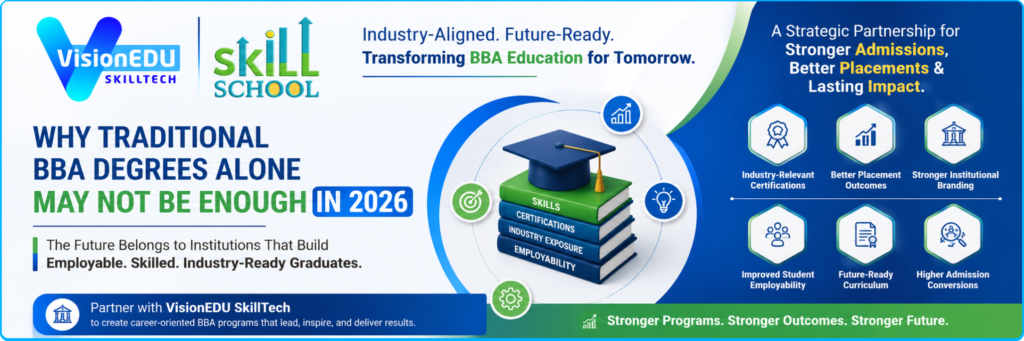
Why Traditional BBA Degrees Alone May Not Be Enough in 2026
The Changing Reality of Management Education
The landscape of business education is evolving faster than ever before. In 2026, institutions offering traditional BBA programs without industry integration, certifications, and employability-focused training may increasingly struggle with admissions, student engagement, and placement outcomes.
Today’s students and parents are no longer selecting colleges based only on infrastructure, affiliations, or brand names. They are asking far more practical questions:
- Will this program lead to a good career?
- Does the curriculum align with industry expectations?
- Are students learning AI, analytics, and digital business skills?
- What are the placement opportunities?
- Will the institution help students become job-ready before graduation?
For institutions, the challenge is no longer just about offering a BBA degree. The challenge is about offering a future-ready management education ecosystem.
The Employability Gap is Growing
One of the biggest concerns across higher education is the widening gap between academic learning and industry requirements.
Traditional BBA programs still focus heavily on:
- theory-based learning,
- conventional examinations,
- outdated case studies,
- and limited industry exposure.
However, employers today expect graduates to possess:
- business analytics capabilities,
- digital communication skills,
- AI awareness,
- practical problem-solving abilities,
- industry certifications,
- and real-world exposure.
This shift is particularly visible across sectors such as:
- Banking & Financial Services
- Digital Marketing
- E-Commerce
- Logistics & Supply Chain
- Business Analytics
- HR Technology
- FinTech
- Startups and Entrepreneurship
Institutions that continue relying only on legacy academic delivery models may face difficulty attracting aspirational students who are increasingly career-focused.
Admissions in 2026 Will Depend on Employability Positioning
Student decision-making patterns have changed significantly.
Today’s admissions are influenced by:
- placement opportunities,
- industry certifications,
- internship exposure,
- AI-integrated learning,
- corporate training,
- and practical skill development.
Parents now evaluate institutions based on Return on Investment (ROI), employability, and career outcomes rather than only academic reputation.
As competition among colleges intensifies, institutions that demonstrate:
- industry relevance,
- placement-oriented learning,
- and skill-based education
will naturally gain a stronger advantage in admissions.
This is where strategic industry-academic partnerships become extremely important.
Why Value-Added Programs Have Become Essential
Value-added programs are no longer optional enhancements. They are becoming critical differentiators for BBA institutions.
Modern BBA students expect exposure to:
- Business Analytics
- Power BI
- AI Tools & Prompt Engineering
- Digital Marketing
- Financial Modeling
- SAP
- Logistics & Supply Chain Management
- HR Analytics
- Entrepreneurship & Startup Skills
- Communication & Corporate Readiness
Institutions integrating such programs within the BBA ecosystem are witnessing:
- improved student confidence,
- stronger placement readiness,
- better industry engagement,
- and enhanced admission appeal.
The Rise of Industry-Integrated BBA Education
The future belongs to institutions that combine:
- academics,
- certifications,
- industry exposure,
- and employability training.
An industry-integrated BBA model helps institutions:
- strengthen their admission positioning,
- differentiate from competing colleges,
- improve placement outcomes,
- enhance institutional branding,
- and create stronger student success stories.
This is precisely where collaboration with VisionEDU SkillTech can create measurable impact.
How VisionEDU SkillTech Helps Institutions Build Career-Oriented BBA Programs
VisionEDU SkillTech focuses on bridging the gap between academics and employability through industry-aligned value-added programs designed specifically for higher education institutions.
The objective is not simply to conduct training sessions, but to help institutions create:
- industry-ready graduates,
- stronger placement ecosystems,
- and admission-oriented academic differentiation.
Key Advantages of Partnering with VisionEDU SkillTech
1. Industry-Relevant Curriculum Integration
Institutions can offer students modern, market-relevant skills alongside the traditional BBA curriculum.
Programs may include:
- Business Analytics
- AI for Business
- Digital Marketing
- Investment Banking
- SAP
- Supply Chain Management
- HR Analytics
- FinTech
- Corporate Communication
This makes the BBA program significantly more attractive to students and parents.
2. Improved Admission Positioning
In a highly competitive education market, institutions need strong differentiators.
A BBA program supported by:
- certifications,
- practical training,
- AI-integrated learning,
- and placement-focused modules
immediately creates stronger market perception.
Institutions can position themselves as:
- industry-oriented,
- employability-focused,
- and future-ready.
This directly supports admission campaigns and improves student inquiry conversions.
3. Enhanced Placement Readiness
Placement outcomes strongly influence future admissions.
VisionEDU SkillTech helps institutions strengthen:
- practical learning,
- corporate exposure,
- communication skills,
- interview readiness,
- and industry certifications.
Students become more confident, employable, and aligned with recruiter expectations.
Better placements naturally lead to:
- stronger word-of-mouth branding,
- improved institutional reputation,
- and higher admission demand.
4. Alignment with NEP 2020 & Skill-Based Education
The Indian higher education ecosystem is increasingly moving toward:
- multidisciplinary learning,
- skill development,
- experiential education,
- and industry collaboration.
Value-added programs aligned with employability and industry readiness support institutional transformation under the evolving education framework.
5. Stronger Institutional Branding
Institutions today must market outcomes, not just degrees.
A partnership-driven, industry-integrated BBA ecosystem helps colleges build stronger visibility through:
- placement success stories,
- certification-driven learning,
- industry projects,
- workshops,
- and career-focused branding.
This creates stronger credibility among:
- students,
- parents,
- academic stakeholders,
- and recruiters.
The Institutions That Adapt Early Will Lead
The management education sector is entering a new phase where:
- employability,
- digital skills,
- AI awareness,
- and industry integration
will define institutional growth.
Traditional BBA models alone may no longer be sufficient to meet the expectations of students, parents, and recruiters in 2026.
Institutions that proactively integrate value-added learning ecosystems will be better positioned to:
- attract quality admissions,
- improve placements,
- strengthen institutional reputation,
- and remain competitive in a rapidly evolving education landscape.
Conclusion
The future of BBA education is no longer limited to classroom-based academic delivery. It is about creating career-ready graduates equipped with practical business skills, industry exposure, and digital capabilities.
Institutions that embrace industry partnerships and value-added learning models will gain a significant competitive advantage in admissions and student outcomes.
A strategic collaboration with VisionEDU SkillTech can help institutions transform traditional BBA programs into modern, employability-focused, industry-integrated learning ecosystems designed for the future of business education.
About VisionEDU SkillTech
VisionEDU SkillTech partners with higher education institutions to deliver industry-oriented value-added programs, certifications, placement-focused training, and future-ready skill development initiatives for students across management and professional education domains.
Connect with VisionEDU SkillTech
📞 9606572295